

This guide serves as an Eagle Rank and Eagle Project roadmap to help Scouts confidently navigate the final steps toward earning the Eagle Scout rank.
This guide was created by Maryam N, and formatted by Cole. You can think of it as a checklist and a timeline combined. Take it step by step, stay organized, and you’ll surely get there!
Many Life Scouts feel overwhelmed not because the requirements are impossible, but because the process feels unclear. This guide is meant to remove that confusion and help you understand what comes next, why each step matters, and how to move through the process efficiently.
Eagle Project Roadmap
This is the full Eagle Project and application flow from start to finish. Each item below links directly to the section that explains it in detail.
- Eagle Project and Idea
- Complete Proposal Pages 7–15
- Get Approvals and Signatures
- Email District or Council
- Eagle Proposal Meeting and Approval
- Begin Fundraiser
- Begin Eagle Project Plan Pages 16–22
- Eagle Project Execution
- Begin Report Pages 26–29
- Reference Letters
- Final Signatures
- Complete Life Purpose and Eagle Application
- Mail Eagle Application for Verification
- Eagle Board of Review
- CONGRATULATIONS YOU’VE DONE IT!
1. Eagle Project and Idea
After Life rank has been completed, the next step is the Eagle Project.
This project is the single largest requirement for Eagle, not because it is meant to be difficult, but because it is meant to demonstrate leadership, planning, and service.
Eagle Project Requirement: While a Life Scout, plan, develop, and give leadership to others in a service project that is helpful to any religious institution, school, or community. (The project must benefit an organization other than the Boy Scouts of America.) A project proposal must be approved by the organization benefiting from the effort, your Scoutmaster/unit committee, and the council or district before you start. To meet this requirement, you must use the Eagle Scout Service Project Workbook, BSA publication No. 512-927
The Eagle Project officially begins once you have an idea. There are many acceptable project types, including building structures, improving outdoor spaces, creating programs, or organizing community resources.
The most important question to ask yourself at this stage is simple: How do I want to give back to my community?
This can be for your school, religious institution, town, or a local nonprofit organization.
Helpful ideas and examples can be found here:
https://scoutsmarts.com/eagle-scout-project-ideas/
ScoutSmarts Tip: Your project does not need to be flashy or expensive. Councils care far more about leadership and planning than scale.
Beginning Notes
- The Eagle Project Workbook can look overwhelming at first because of its length, but it is much simpler than it appears.
- Many of the pages are short prompts or filler. Roughly half of the workbook does not require long written responses.
If you take the workbook one section at a time, it becomes very manageable.
For Scouts Close to Age 18
I can NOT stress this enough. You must make sure you have enough time to complete everything before your 18th birthday.
While there is limited flexibility in rare circumstances, councils only approve extensions when there is a legitimate, well-documented reason. These approvals are difficult to obtain and should never be relied upon.
You should plan enough time for:
- Paperwork and proposal writing (days to weeks)
- Getting signatures and approvals
- Fundraising (weeks to months)
- Project execution (days to weeks)
- Eagle application processing and Board of Review scheduling
For reference, it took two months for my Board of Review date to be scheduled after my application was approved. This timeline varies by council and can range from days to several months.
When everything is considered, earning Eagle typically takes anywhere from a few months to over six months.
Be efficient. Do not delay emails, signatures, fundraising, or submissions.
With that, I wish you all the luck, and may the journey begin.
ScoutSmarts Reminder: Work backward from your 18th birthday and add buffer time at every stage.
Workbook Explained
[Proposal, Project Plan, Report]
The Eagle Scout Service Project Workbook is where all written planning, approvals, and reflections are documented.
It is divided into three major sections:
- Proposal: What you plan to do and how
- Project Plan: Detailed execution planning
- Report: What you actually did and what you learned
Each section builds on the previous one and must be completed in order.
2. Complete Eagle PROPOSAL Pages 7–15

The Eagle Proposal is where you explain what you plan to do and how you plan to do it. This section does not need to be perfect, but you should have a clear idea of your project and goal outcomes.
Once you have formed an idea, it is highly recommended that you first outline your project in a separate document.
Example document: Community Garden Eagle Project (you can make a copy for yourself and edit from there).
Communicate with your beneficiary before submitting the proposal to make sure their concerns, preferences, and expectations are addressed early.
Using a document first makes the project feel less overwhelming and makes it much easier to transfer information into the workbook later.
If your project costs more than $1,000, you must complete the Eagle Scout Fundraising Application and obtain the required approvals and signatures.
3. Get Approvals and Signatures
Once your proposal pages are complete, you must collect approvals in the correct order.
First, formally present your proposal to the project beneficiary. Send them your Google Doc, include drawings or plans, and set up a meeting to discuss changes, concerns, and questions. After this meeting, obtain their signature.
Next, present the same materials to your Scoutmaster and Unit Committee Chair and obtain their signatures.
Tip for Signatures: Using digital signature tools can cause the workbook to lock. Always make a copy first, or print the signature page, sign it physically, scan it, and reattach it.
This step may feel repetitive, but it ensures that all parties understand and approve the project before it moves forward.
4. Email District or Council
Once you have completed the proposal and gathered all required signatures, you must email your district or council for final proposal approval.
This approval is required before you may begin fundraising or project execution.
Example Email
Subject: Eagle Proposal – [Full Name], Troop [Number]
Hello _______!
I hope your day is going well. My name is ________, and I am a Life Scout in Troop _____. I am looking forward to starting my Eagle Project and have completed my Eagle Project Proposal.
I was wondering when you would have time to discuss it and what changes you would like for me to make before you sign off on it.
I have attached the Eagle Workbook pages 7–15 along with the scanned signature page.
Please let me know when you are available. I look forward to hearing from you.
Thank you,
(your name)
Troop _____
Attach: Proposal pages 7–15, signature page, drawings, and fundraising application if required.
5. Eagle Proposal Meeting and Approval
Many councils require an Eagle Proposal Meeting. This meeting can feel intimidating, but it is designed to help you succeed.
(Applies to Golden Gate Area Council, Mission Peak District and similar councils.)
- You will meet with other Life Scouts from different troops
- The committee will review next steps, expectations, and common pitfalls
- You may receive a slideshow or additional resources
Come prepared with questions about materials, safety, fundraising, or logistics.
Once the district representative signs your proposal, you are officially approved to move forward.
In many cases, signatures are given the same day, but it may take a few days depending on council schedules.
Remember that committees are not trying to block projects. They are checking for safety and leadership readiness.
6. Begin Fundraiser
Once your proposal is approved, begin fundraising as soon as possible.
LaunchGood and GoFundMe are both popular options and have similar fees and processing times.
- I used LaunchGood. If you need help, send me an email. The process is fairly simple.
- Use a parent’s name and banking information when setting up payouts.
Keep in mind that funds are usually not released until the fundraiser ends. During this time, plan your project carefully and purchase materials with the understanding that you may reimburse your parents later.
Sample Campaign Pitch
Hello Everyone,
My name is ______, and I am a Life Scout from Troop _____. I am raising money for my Eagle Project.
An Eagle Project is a service project completed by Life Scouts to give back to their community. My project is a __(describe project)__ at (location).
Growing up, the masjid has always held a special place in my heart. I live just a few minutes away and have always admired the serene atmosphere created by the trees and natural surroundings.
One day, while walking past a small patch of barren land near the women’s entrance, I wondered how it could be transformed into something meaningful. Inspired by a vision shared by my dad, I decided to take on this project.
My goal is to create a vibrant community garden where people can gather, plant vegetables, native plants, and flowers, and enjoy a clean, welcoming space.
Your support will help beautify our community, encourage togetherness, and create a greener environment for everyone.
Thank you for your support.
ScoutSmarts Tip: Start by sharing your fundraiser with family, troop parents, and community leaders.
7. Begin Eagle PROJECT PLAN Pages 16–22
The following pages are super simple to fill out. Keep in mind that you do not need to type out multiple paragraphs for every response. Anywhere from 2–4 sentences is usually enough. Some prompts only require a basic statement, while others ask for a short explanation.
I strongly advise keeping track of all costs as you go and entering them into page 19 as items are purchased. Yes, it can feel tedious, but it will save you a lot of time later.
The rest of the plan is also very simple to complete. While it may look daunting at first, it typically takes less than 30 minutes to fill out the basic information and questions once you are prepared.
Outside of the workbook itself, this is the phase where you should be planning out every detail of your project, including:
- Building steps
- Materials
- Costs
- Exceptions or adjustments
Remember: 80% Planning, 20% Execution. Plan everything out, and the rest will come easy.
Tips
- Drawing out your ideas can help visualize the final result
- Visiting hardware stores and talking to specialists can guide better decisions
- Create small or mini prototypes to catch mistakes early and adjust as needed
- Split your project into phases so you can focus on one area at a time instead of jumping around
While every Eagle Project is different, there are plenty of resources available. Many Eagle Scouts have completed similar projects and are often willing to offer guidance.
8. Eagle Project Execution
Execution of Project:
Split the work into specific days and send out emails or messages to volunteers ahead of time. Volunteers can include friends, family members, and fellow Scouts.
EAGLE PROJECT IS ALL ABOUT LEADERSHIP
This means that you cannot complete the project by yourself. You must take a step back and guide people instead of doing all the work.
Make sure to provide water and snacks on workdays, and ensure that volunteers have access to:
- First aid
- Bathrooms
- Shade or breaks if needed
9. Begin REPORT Pages 26–29
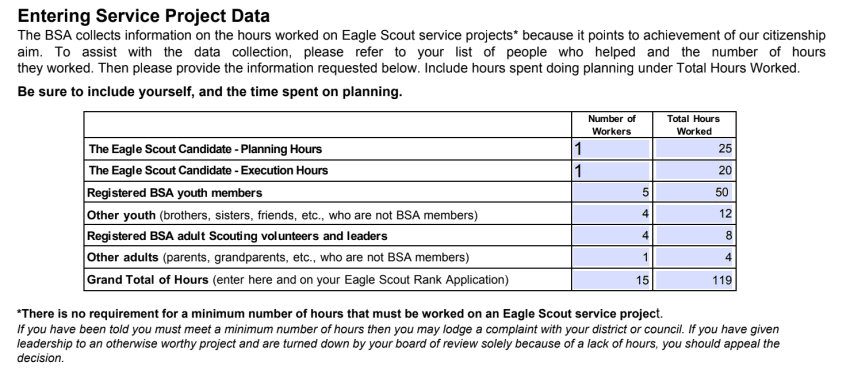
- It will always be one person for planning hours and execution hours
- This is just an example of how my chart looked like
The following pages are simple to complete, but this is where you should slow down and explain things clearly.
Be sure to describe:
- How you carried out the project
- What you did during planning and execution
- What you enjoyed about the project
- What you learned from the experience
10. Reference Letters
Your district will provide a document titled Letter to Providers of References, which must be attached when requesting letters.
You will need a total of five reference letters from the following categories:
- Parent
- Educational reference
- Religious reference
- Employer (if applicable)
- Two additional references
In these letters, the writers will describe how you have demonstrated the characteristics of the Scout Oath and Scout Law in your daily life.
Example Email: Asking for a Reference Letter
Hello (Recipient Name),
I hope you are doing well. As you may or may not know, I have been part of Boy Scouts for around five years, and during that time I have learned many useful skills and values that have helped me become a better member of my community.
I am one rank away from becoming an Eagle Scout, which is the highest rank that Scouting offers, and I am currently collecting references for the next stage of the process.
I really enjoyed learning from you and was hoping that you would be willing to describe our interactions and my contributions for my Eagle Board of Review.
Would you be willing to submit a positive reference on my behalf? I can send more detailed information if you are interested.
Thank you,
(your name)
Example Email: Response if They Accept
Hello (Recipient Name),
I hope you are doing well. An Eagle Recommendation Letter supports a Life Scout’s candidacy for Eagle Scout, the highest achievement in the Boy Scouting Program.
For the past five years, I have been part of Boy Scouts, and during that time I have learned many useful skills and values to become a better member of my community.
I am one rank away from becoming an Eagle Scout, and I truly appreciate your willingness to write a reference letter on my behalf.
Here are a few important things to keep in mind (this may vary depending on council):
- Please mail the letter by: (_this date_)
- Follow the provided reference letter envelope exactly, or the letter may not be accepted (applies to Golden Gate Area Council, Mission Peak District)
- The only information that should be changed on the envelope is your return address and the Eagle Scout candidate’s name
Thank you again,
(your name)
Make sure to attach the Letter to Providers of References document, which should be included in your Google Drive (applies to Golden Gate Area Council, Mission Peak District).
For more info on writing and submitting your reference letters, be sure to check out the ScoutSmarts Eagle Scout Letters of Recommendation article.
11. Final Signatures
Once you have completed the workbook and finished the project itself, set up a meeting with the project beneficiary to review everything and obtain their final signature.
After that, email your Scoutmaster with:
- The completed Eagle Workbook
- All project photos
- A Google Drive containing supporting materials
Set up a meeting with your Scoutmaster to review the materials and obtain their signature.
If you want to save time, you may prepare your Eagle Application ahead of time and complete the following on the same day:
- Eagle Scoutmaster Conference
- Signature on the Eagle Workbook
- Signature on the Eagle Application
This is optional, but it can help streamline the process.
Make sure to also schedule your Eagle Scoutmaster Conference. This can occur on the same day as workbook signatures.
Tip for Signatures: Using digital signature tools can cause the workbook to lock. Always make a copy first or print the page, sign physically, scan it, and reattach it before sending to council.
12. Complete the Life Purpose and Eagle Application
Statement of Ambitions and Life Purpose
An Eagle Scout Statement of Ambitions and Life Purpose is a short essay written by an Eagle Scout candidate that explains their goals, values, and mindset.
The statement is typically divided into four parts:
- Introduction
- Short-term goals
- Long-term goals
- Life purpose
The following resources will help you format and write your statement:
- Personal Example: Eagle Scout Statement of Ambition and Life Purpose
- ScoutSmarts – Writing A Statement of Ambition and Life Purpose Guide
You must also include a list of leadership positions you have held in your religious institution, school, camp, community, or other organizations. Be sure to include any honors or awards received during this service.
Eagle Application
Submitting the Eagle Scout Rank Application is the final task after completing all Eagle rank requirements.
Make sure to retrieve all required dates from Scoutbook, including merit badges, ranks, and Boards of Review.
Scoutbook → My Activity Logs → [Joining Date]
Eagle Scout Application Scouts BSA Links
Be precise when copying dates from Scoutbook, especially:
- Merit badge completion dates
- Rank Boards of Review
- Leadership positions and dates served
Once completed, schedule a meeting with your Scoutmaster and Unit Committee Chair for final signatures.
13. Mail Eagle Application for Verification
You are almost there!
Mail the Eagle Application and Statement of Ambitions and Life Purpose together in an envelope to your local council. (Applies to Golden Gate Area Council, Mission Peak District.)
You must also email your council with the following materials:
- Completed Eagle Workbook
- All signatures
- Project photos
- Drawings and diagrams
Sample Email
Hello,
I hope you are doing well. I have completed my Eagle Project and mailed my Eagle Application to the Council.
Attached is a Google Drive containing my Eagle Workbook, signatures, Eagle Scout Statement of Ambitions and Life Purpose, and project photos and drawings.
I am requesting my Eagle Board of Review date, as I have completed all project and rank requirements.
I look forward to hearing from you.
Thank you,
(your name)
Troop _____
Google Drive Organization
Create a Google Drive folder with clearly labeled subfolders, such as:
- Paperwork
- Photos
- Drawings and Diagrams
This will help keep everything organized and easy to access.
I also recommend creating a physical binder with printed paperwork, drawings, diagrams, and notes to bring to your Board of Review.
14. Eagle Board of Review
Once your application has been verified, you will receive confirmation from the council that your dates, merit badges, leadership positions, and paperwork are valid.
Your Eagle Board of Review may be in person or online.
Personal experience: My Board of Review was online. I was asked questions about:
- How I planned and led my Eagle Project
- My overall experience in Scouting
- Campouts, events, and leadership roles
- What I learned from the Eagle process
The Board of Review can feel intimidating, but the hardest part is already done.
You have completed the paperwork, the physical labor, and dedicated years to Scouting.
Relax, answer questions honestly and thoughtfully, and trust the work you have done.
You have earned this.