
Imagine standing in front of a packed court of honor, your whole troop, leaders, and parents watching, and you’re the one running the show. Every word you say is spoken with confidence, and you sense your audience listening intently. That’s the power behind the Communication merit badge! By earning this Eagle-required badge, you learn how to lead with your voice, your writing, and your presence in ways people actually listen to.
Working on Communication means building on skills you already use in Scouting and school. You’ll keep a log of how you communicate, give a five-minute speech, interview someone you respect, and plan and run a campfire program or court of honor without losing control of the crowd or putting yourself in an awkward spot. You’ll also write, publish, or design something others can read and understand clearly.
In this article, we’ll break down why the Communication merit badge matters, then walk through each requirement with clear difficulty ratings and practical tips. We’ll talk about speaking confidently, listening actively, and organizing events so they run smoothly. You’ll also get resource suggestions and strategies to make each step easier. Ready to start communicating like a leader? 🙂
Why The Communication Badge Is Important
At its core, the Communication merit badge teaches Scouts that clear communication is what turns thoughts into action. Whether you’re speaking, writing, or leading a meeting, the way you communicate often decides whether people understand you or end up confused.
Communication Merit Badge Overview (Eagle-Required)
| Merit Badge Name: | Communication |
| Creation Date: | 1965, originally introduced to emphasize public speaking and modern media as Scouting updated its program for the television era |
| Badge Difficulty: | 8 – Challenging (multiple presentations, writing tasks, and event planning spread over several meetings) |
| Top 3 Skills Covered: |
|
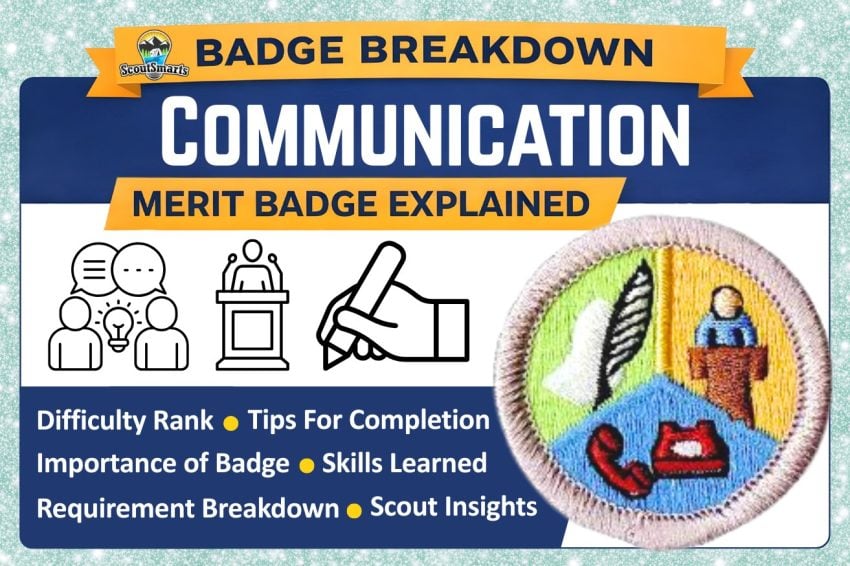
| Fun Fact: | The Communication merit badge was created as part of a mid-1960s update to include modern media, and its design of a microphone and letter reflects both spoken and written communication. Originally called “Communications”, in 2010 the s was dropped and the requirements were revised. Source |
| Ideal Ages To Earn: | 15–17 |
| Merit Badge Pamphlet: | Communication Merit Badge Pamphlet Link |
What Are The Communication Merit Badge Requirements?
For Communication, planning ahead is crucial. I’d suggest using the table below to map out your progress. Most Scouts start by knocking out requirement 1 early (because it can involve a 1 to 3 day log), then schedule their speech for requirement 3 and their public meeting for requirement 5. These often take the most coordination. Try to combine speaking-related requirements (2, 3, 4, 6, 8) within the same meetings or events so you get plenty of practice at once.
| Req # | Requirement Summary | Requirement Group | Difficulty | ScoutSmarts Notes & Tips |
|---|---|---|---|---|
| 1 | 1. Do ONE of the following: a. For one day, keep a log in which you describe your communication activities. Keep track of the time and different ways you spend communicating, such as talking person-to-person, listening to teachers, listening to the radio or podcasts, watching television, using social media, reading books and other print media, and using any electronic communication device. Discuss with your counselor what your log reveals about the importance of communication in your life. Think of ways to improve your communication skills. b. For three days, keep a journal of your listening experiences. Identify one example of each of the following, and discuss with your counselor when you have listened to each: obtain information, be persuaded, appreciate or enjoy something, and understand someone’s feelings. c. In a small-group setting, meet with other Scouts or with friends. Have them share personal stories about significant events in their lives that affected them in some way. Take note of how each Scout participates in the group discussion and how effectively each Scout communicates their story. Report what you have learned to your counselor about the differences you observed in effective communication. d. List as many ways as you can think of to communicate with others (face-to-face, by telephone, letter, email, text messages, social media, and so on). For each type of communication, discuss with your counselor an instance when that method might not be appropriate or effective. | Intro Communication & Logs | Medium | Treat this as a “gatekeeper” requirement and start it first. If you pick 1a or 1b, set reminders on your phone so you do not forget to log entries. For 1c, use a patrol meeting or game night to gather people, and jot notes right after the stories while they are fresh. For 1d, brainstorm with your family or patrol so you can list more methods and examples quickly. |
| 2 | 2. Do ONE of the following: a. Think of a creative way to describe yourself using, for example, a collage, short story or autobiography, drawing or series of photographs, or a song or skit. Using the aid you created, make a presentation to your counselor about yourself. b. Choose a concept, product, or service in which you have great confidence. Build a sales plan based on its good points. Try to persuade the counselor to agree with, use, or buy your concept, product or service. After your sales talk, discuss with your counselor how persuasive you were. | Self Presentation & Persuasion | Medium | 2b is usually fastest because you can “sell” something you already like, such as a hobby, app, or camping item. Outline three main points and a clear call to action. Practice once with a parent or friend so you feel smoother when presenting to your counselor. |
| 3 | 3. Write a five-minute speech. Give it at a meeting of a group. | Public Speaking | Hard | Aim for about 500 to 700 words for a five-minute speech. Ask your SPL or teacher if you can give it at a troop meeting, class, or club. Use note cards with bullet points instead of reading word for word so you can make eye contact. |
| 4 | 4. Interview someone you know fairly well, like, or respect because of his or her position, talent, career, or life experiences. Listen actively to learn as much as you can about the person. Then prepare and deliver to your counselor an introduction of the person as though this person were to be a guest speaker, and include reasons why the audience would want to hear this person speak. Show how you would call to invite this person to speak. | Interview & Introduction | Medium | Choose someone who enjoys talking, such as a teacher, coach, or relative. Prepare 6 to 10 open-ended questions beforehand. After the interview, write a short 1 to 2 minute introduction highlighting what makes them interesting to an audience. Practice saying your “phone call” script out loud. |
| 5 | 5. Attend a public meeting (city council, school board, debate) approved by your counselor where several points of view are given on a single issue. Practice active listening skills and take careful notes of each point of view. Prepare an objective report that includes all points of view that were expressed, and share this with your counselor. | Public Meeting & Reporting | Hard | This one can be tricky to schedule, so pick a meeting date early and clear it with your counselor. During the meeting, divide your notes by speaker and by viewpoint so writing your objective report later is much easier. |
| 6 | 6. With your counselor’s approval, develop a plan to teach a skill or inform someone about something. Prepare teaching aids for your plan. Carry out your plan. With your counselor, determine whether the person has learned what you intended. | Teaching & Planning | Medium | Choose a simple skill you already know well, such as tying a specific knot, starting a campfire, or basic first aid. Make one or two quick teaching aids, like a handout or diagram. Teach this during a patrol meeting so your counselor or a registered adult can observe or confirm it. |
| 7 | 7. Do ONE of the following: a. Write to the editor of a magazine or your local newspaper to express your opinion or share information on any subject you choose. Send your message by fax, email, or regular mail. b. Create a webpage or blog of special interest to you (for instance, your troop or crew, a hobby, or a sport). Include at least three articles or entries and one photograph or illustration, and one link to some other webpage or blog that would be helpful to someone who visits the webpage or blog you have created. Note: It is not necessary to post your webpage or blog to the internet, but if you decide to do so, you must first share it with your parent or guardian and counselor and get their permission. c. Use desktop publishing to produce a newsletter, brochure, flyer, or other printed material for your troop or crew, class at school, or other group. Include at least one article and one photograph or illustration. | Written & Digital Communication | Medium | Pick the option that best matches tools you already use. 7a is simplest if you enjoy writing; 7b is great if you like web design; 7c fits school or troop projects. Before starting, ask your counselor which option they recommend and what proof they want to see. |
| 8 | 8. Plan a troop or crew court of honor, campfire program, or an interfaith worship service. Have the patrol leaders’ council approve it, then write the script and prepare the program. Serve as master of ceremonies. | Event Planning & Leading | Hard | Coordinate this with your SPL and Scoutmaster early because it affects a whole troop event. Use a written run-of-show agenda with times and speaker names. Practice your MC parts so you can speak clearly and keep the program on schedule. |
| 9 | 9. Find out about three career opportunities in communication. Pick one and find out the education, training, and experience required for this profession. Discuss this with your counselor, and explain why this profession might interest you. | Careers in Communication | Easy | Look up careers such as journalism, public relations, marketing, broadcasting, or graphic design. You can research online and then talk to one adult in that field, either in person or by video call, for more detail before you speak with your counselor. |
Also, make sure to check out the full Communication badge page and requirements from Scouting America.
Why Scouting America Includes The Communication Badge
The Communication badge trains you to think before you speak, listen carefully, and choose the right words for the situation. When you can explain ideas clearly, you instantly become more trusted as a leader, friend, and teammate. This badge gives you real practice doing that in speeches, interviews, and group settings.
Strong communication builds character because you must plan, pay attention, and take responsibility for how your message affects others. You learn to see multiple sides of an issue, stay calm under pressure, and share information fairly. Those habits help you in school discussions, family decisions, and tough situations where emotions run high.
As you plan meetings, teach skills, and lead ceremonies, you’ll even start thinking ahead about timing, audience, and goals. That ability to anticipate what might happen and prepare your message is huge for sports, jobs, and any leadership role you take on later. Communication is the thread that connects your ideas to real-world action! 😀
Who The Communication Badge Is Great For
Communication is Eagle-required and usually fits best for Scouts around Star or Life rank who have more extensive troop leadership experiences under their belt. The badge is quite challenging, so it is great if you are around 15 or older and ready to be thoughtful and organized with your requirements.
If you enjoy debating, acting, writing, podcasting, or running meetings, you will feel right at home here. Careers like law, teaching, business, marketing, broadcasting, counseling, and public relations all rely heavily on these skills. This badge gives you an early taste of how those paths work in the real world.
When I worked on the Communication badge, I initially thought it would just be “giving a speech.” What really happened was I learned how to listen, plan, and speak so people actually cared. That badge gave me the confidence to lead campfire programs, handle interviews, and speak up for what mattered. It was a huge boost for my leadership skills too!
– Cole K
Insider Tips to Finish Communication Faster
Communication has several moving parts that stretch over days and involve real events, meetings, and people. If you try to “wing it,” it drags on. However, if you plan ahead, batch similar requirements, and talk with your counselor early, you can typically finish in around 1-2 months and actually enjoy the process.
- Meet your counselor first and map everything. Bring the requirements and ask, “Which ones are hardest for your Scouts?” and “What deadlines should I set?” This gives you a clear game plan before you start logging, writing, or attending meetings.
- Tackle the “gatekeeper” requirements early. Requirements 1 (logs/journal), 3 (five-minute speech), 5 (public meeting), and 8 (court of honor/campfire/worship service) almost always slow Scouts down. Schedule those first on your calendar so everything else can fit around them.
- Use batching to save time and mental energy. Plan to work on related tasks together. For example, write your five-minute speech (Req 3) and your teaching plan (Req 6) in the same week, since both involve organizing information and preparing to present.
- Double-purpose real events you already attend. Going to a city council or school board meeting for class or another badge can cover Requirement 5 if your counselor approves. Always ask ahead of time so you know what kind of notes and report they want.
- Pick Requirement 1 and 2 options that fit your strengths. If you like writing, choose the listening journal (1b) and a creative story or autobiography (2a). If you enjoy persuading or selling, go for 1d and the sales pitch option (2b). Playing to your strengths keeps the badge fun.
- Use people you already know for the interview (Req 4). A coach, teacher, religious leader, or family friend with an interesting job is perfect. Tell them, “For my Communication merit badge, I need to interview you about your work and life. Could we set up 20-30 minutes sometime this week?”
- Practice your five-minute speech out loud with a timer. Aim for 4:30 to 5:30 minutes. Record yourself once on your phone and notice where you speak too fast, say “um” a lot, or lose your point. Fix those areas, then give the speech at a troop meeting or class.
- When planning your court of honor or campfire (Req 8), reuse proven formats. Ask your SPL or an older Scout if you can see a past script. Adapt it instead of starting from zero. You still need to write the final script and act as MC, but you will have a roadmap.
- Be professional when talking with your counselor. Before interviews or big steps, send a short message: “I plan to do Requirement 5 at the next school board meeting on [date]. Will that work, and is there anything specific you want me to focus on in my notes?” This shows maturity and avoids re-doing work.
- For the media/online options (Req 7), choose something you will actually use. A small troop newsletter, a hobby blog, or a flyer for a school club all count. Picking something meaningful makes the writing and design feel less like homework and more like real impact.
The Most Important Skills You’ll Learn
Communication gives you real reps in speaking, listening, writing, and planning events. The cool part is that almost every requirement mirrors something adults do in their jobs all the time.
If you stay focused on the deeper skills you’re building, this badge stops feeling like a checklist and starts feeling like training for your future! Some of the most important skills you’ll develop while earning Communication are:
- Clear Speaking: Writing and giving a five-minute speech trains you to organize your thoughts and share them confidently. This skill matters in interviews, class presentations, and tough conversations.
- Active Listening: You practice listening to understand, not just waiting to talk. This makes you a better friend, teammate, and leader because people feel heard and respected.
- Respectful Discussion: At public meetings and group activities, you see how different people handle disagreements. Learning to stay calm and fair in those moments prepares you for leadership roles where people will not always agree with you.
- Planning and Organization: Planning ceremonies, lessons, or programs forces you to think ahead, assign roles, and manage time. That same planning mindset helps with big school projects and managing your schedule.
- Professional Writing: Writing letters to editors, scripts, or online content shows you how to share your views clearly and respectfully. That is useful for emails to teachers, bosses, or anyone you need to persuade.
- Confidence in Social Situations: Interviewing someone, calling a guest speaker, or acting as MC builds social courage. You get used to stepping up instead of hiding in the background.
When you keep these skills in mind, you start seeing chances to practice them everywhere – in your troop, at school, and online. The more you use them, the more people will naturally look to you as a leader. Now, we’re ready to go over FAQs so you’re prepared for any questions that may come up as you complete this badge!
Communication Merit Badge FAQs
Is Communication merit badge Eagle-required, and when should I earn it?
Yes, Communication is required for Eagle. Most Scouts benefit from doing it around Star or Life rank, often between ages 14 and 16. By then, you have more leadership positions, access to meetings and ceremonies to plan, and the maturity to handle interviews, speeches, and thoughtful writing.
What is the hardest requirement for Communication?
For many Scouts, Requirement 8 is the hardest, because you must plan a full court of honor, campfire, or worship service, get PLC approval, write the script, and serve as MC. The key is to schedule it early, coordinate with your SPL and adult leaders, and reuse proven formats instead of starting from zero.
Do I have to give my five-minute speech (Requirement 3) at a troop meeting?
No. The requirement says “at a meeting of a group,” so options include a troop meeting, class presentation, club meeting, church group, or even a family meeting if your counselor approves. Just make sure your audience is real, not just one person, and get your counselor’s okay beforehand.
How formal does my public meeting report (Requirement 5) need to be?
Usually, it should be a neat, organized written report that fairly represents each point of view. Ask your counselor if they prefer typed or handwritten. Focus on being objective: summarize who said what and why, instead of taking sides or arguing your own opinion.
Can I use online tools for the newsletter, blog, or webpage (Requirement 7)?
Yes. Simple site builders, Google Docs for a newsletter, or basic blogging platforms work fine. If you plan to publish anything online, you must share it with your parent or guardian and counselor first and get their permission. Content should be Scout-appropriate and respectful.
What if I am shy or nervous about public speaking?
That is completely normal. Start small: practice your speech in front of a mirror, then a parent, then a buddy. The badge is not about being perfect – it is about getting better. Your counselor knows many Scouts are nervous and will support you if you put in honest effort and practice.
Can I double-count events or work with other merit badges?
Sometimes. For example, a city council meeting for Citizenship badges might also count for Requirement 5, if your counselor approves and you take notes with Communication in mind. Always ask first, and remember that your written work and reports should be your own, tailored to this badge.
Resources For Earning Your Communication Badge
Helpful Communication Resources
These links will support your work on the Communication merit badge.
Plan ahead for your speech, public meeting, and ceremony requirements, and check in with your counselor early so you only need to complete each task once, the right way.
Now you have everything you need to knock out Communication and grow into a stronger leader at the same time! If you take the requirements seriously, you’ll notice a real difference in how confidently you speak, listen, and lead in your troop and at school. Step by step, you will see that you are capable of a lot more than you thought. 🙂
If you want even more help, you can pick up the official Communication merit badge pamphlet on Amazon, and follow the full step-by-step ScoutSmarts Communication Merit Badge Guide to help complete each requirement. Put in honest effort, use these resources, and you’ll come out of this badge prepared for the conversations and leadership roles that shape your future. You got this!